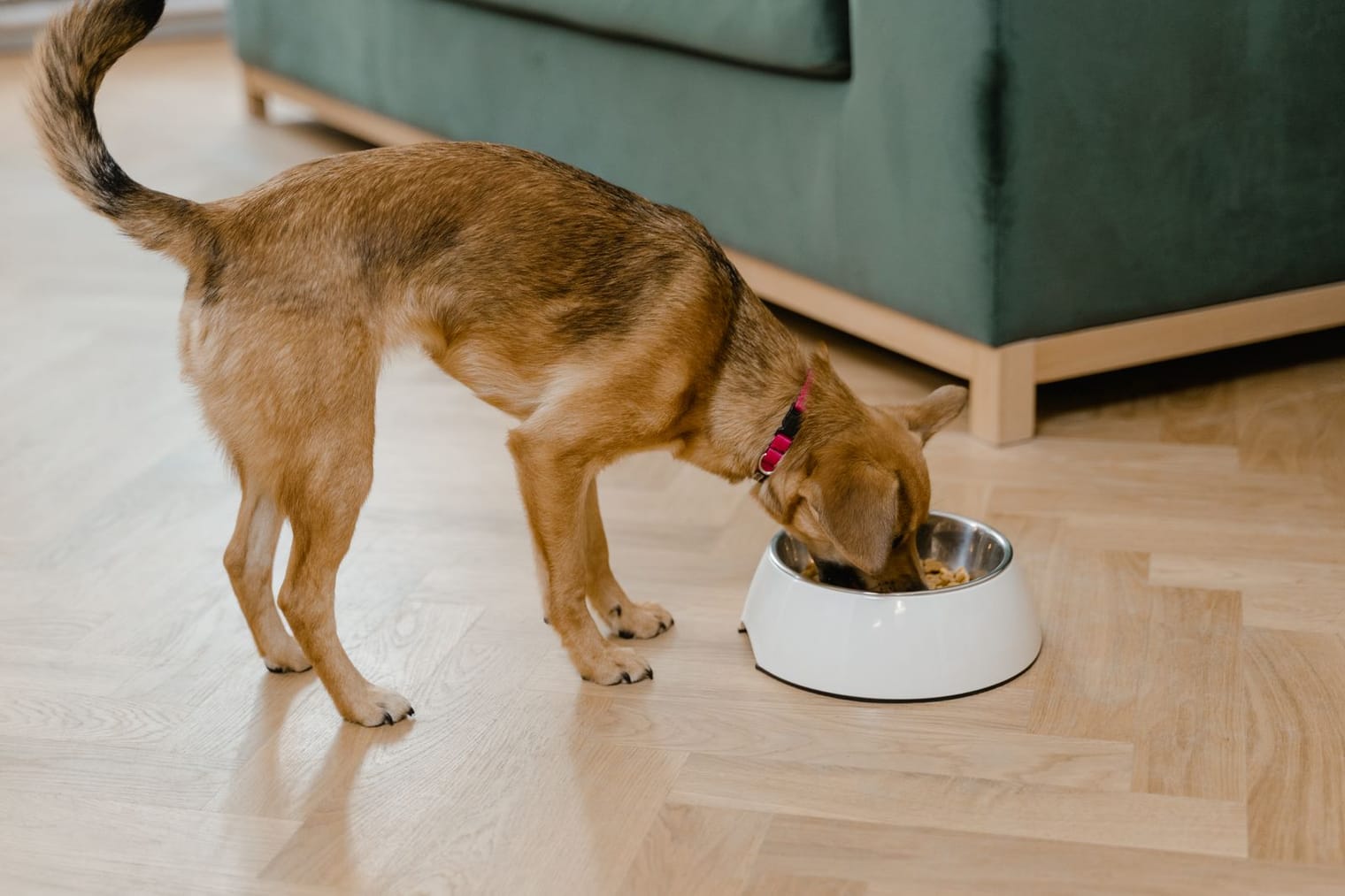
If you have a new puppy and you are staring at the back of the food bag wondering whether the amount is right, you are not doing anything wrong. This is one of the most confusing parts of the first few weeks, and almost every first-time owner hits it. The good news is that getting it right is less about finding one magic number and more about following a simple, reliable order: start from the food, feed to the puppy in front of you, and adjust as they grow.
Why every source gives a different number
The bag says one thing, the breeder said another, and three websites gave you three more answers. It is maddening, but there is a reason for it, and once you see it the confusion clears.
Feeding amounts are really about calories, not grams. Every puppy food packs a different number of calories into each gram, so a rich, energy-dense food needs fewer grams than a lighter one to give the same energy. That is why you cannot simply carry a gram figure from one food to another. On top of that, breeders often fed a different brand, generic charts assume an average puppy that may not be yours, and older advice tends to overfeed.
The reliable anchor is your own food's feeding guide, matched to your puppy's weight and age, then adjusted to how your puppy actually looks and feels.
Step 1: Start with your food's own guide
Turn the bag over and find the feeding table. It will list a daily amount by the puppy's current weight and often by age. Use that as your starting figure, because it is calculated for the calories in that specific food. If you feed wet food, or a mix of wet and dry, the packet will usually tell you how to combine them, and the daily amount still holds as long as you count everything that goes in the bowl.
Two things worth knowing: feeding guides are usually generous, so the middle of the range is a sensible place to begin, and the figure is a daily total, not a per-meal amount.
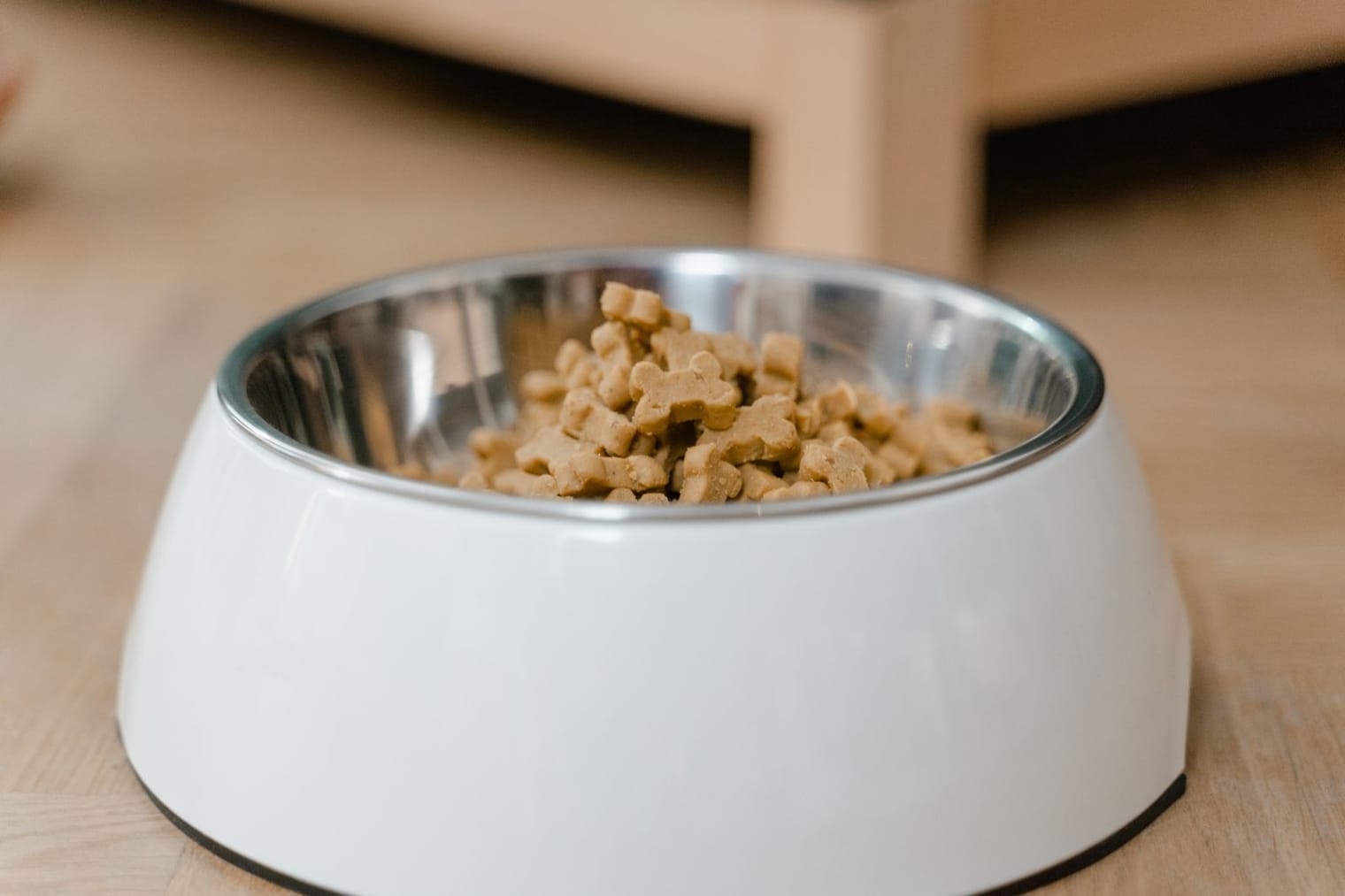
Step 2: Split it across the day
Puppies have small stomachs and steady energy needs, so the daily amount is divided into regular meals rather than fed all at once. As a rough guide:
- Up to 4 months: four meals a day.
- 4 to 6 months: three meals a day.
- 6 months and beyond: two meals a day, which most dogs stay on for life.
Regular mealtimes do more than feed. They steady the blood sugar of very young puppies, they make toilet habits far more predictable, and they give the day a rhythm that helps a puppy settle.
Step 3: Adjust to body condition, not the bag
This is the step almost everyone skips, and it is the one that matters most. The number on the bag gets you close, but your puppy is the final word. Rather than chase a figure, learn to read their body. A hands-on check takes ten seconds and tells you more than any chart:
- Ribs: you should be able to feel them easily under a thin layer of covering, without pressing hard. If you cannot feel them, ease the food back a little. If they feel sharp and stick out, feed a little more.
- Waist: looking down from above, there should be a gentle narrowing behind the ribs.
- Tuck-up: from the side, the tummy should rise up towards the back legs rather than hang level.
Check every couple of weeks and adjust slowly. Small changes are all a growing puppy needs, and they add up.
Feed the puppy in front of you today, not the dog they will become. Feeding to a future adult weight is one of the most common ways puppies are overfed.
Feed to today's weight, especially for big breeds
It is tempting to feed a large-breed puppy generously to help them grow. It is also a mistake. In large and giant breeds, growing too fast is a recognised risk factor for joint and bone problems later on. Slow, steady growth is healthier for their joints than a rapid spurt. So feed to your puppy's current weight, keep them lean rather than round, and let them take the time their breed needs to finish growing. If you are not sure what is right for your breed, this is a good thing to raise with your vet.
Where treats fit in
Treats count. A useful rule from vets is that treats should make up no more than about a tenth of a puppy's daily food, with the rest coming from a complete, balanced diet. During training, when the treats add up quickly, you can set aside a portion of the daily meal allowance to hand out as rewards, or use small pieces of their own kibble, so the extra does not tip the balance.
A quick word on raw and home-cooked diets
Growing puppies have precise nutritional needs, and getting the balance of calcium and phosphorus wrong while the skeleton is forming can cause lasting harm. If you want to feed raw or home-cooked, the safe route is a complete diet formulated to a recognised puppy growth standard, or a recipe designed by a veterinary nutritionist. It is not something to improvise from online recipes, and it is worth a conversation with your vet first.
Vivlo works your puppy's daily amount out from their weight, age and the food you actually feed, then keeps it in step with their body condition as they grow. No more guessing from the back of the bag.
Try the feeding calculatorWhat is normal, and when to call the vet
Most feeding wobbles sort themselves out with small adjustments and a bit of patience. Some things are worth a call to your vet rather than a change to the bowl: a puppy who is losing weight or not gaining during active growth, one who suddenly goes off their food, repeated vomiting or diarrhoea, or a puppy who seems ravenous yet stays thin. Feeding is one of the clearest early signals that something has changed, so trust it, and when in doubt, ask.
Common questions
How much should I feed my puppy a day?
Start with the daily amount printed on your puppy food, matched to your puppy's current weight and age, then split it across the right number of meals. Treat that figure as a starting point and adjust it up or down based on your puppy's body condition over the following weeks. Puppies vary, so the packet is a guide, not a fixed rule.
Why do different sources give different feeding amounts?
Because they are answering slightly different questions. Food packets are calculated for the calories in that particular food, so a richer food needs fewer grams than a lighter one. Breeders, websites and calculators may assume a different food, a different activity level or a different age band. The reliable anchor is your own food's feeding guide, adjusted to how your puppy actually looks and feels.
How many times a day should I feed my puppy?
Most puppies do best on four meals a day up to about four months, three meals from four to six months, and two meals from around six months onwards. Splitting the daily amount into regular meals keeps energy and toilet habits steady and is easier on a small stomach.
Should I feed my puppy based on their current weight or their expected adult weight?
Feed to their current weight, then check body condition. Feeding to a future adult weight risks overfeeding a young puppy, which is a particular concern in large and giant breeds. The safest approach is to feed for the puppy in front of you today and adjust as they grow.
How do I know if I am feeding my puppy the right amount?
Use body condition rather than the number on the bag. You should be able to feel your puppy's ribs easily under a thin layer, see a slight waist from above, and see a tuck-up in the tummy from the side. If the ribs are hard to feel, ease back slightly. If they are sharply visible, feed a little more and speak to your vet. Steady, gradual growth is the goal, not fast growth.